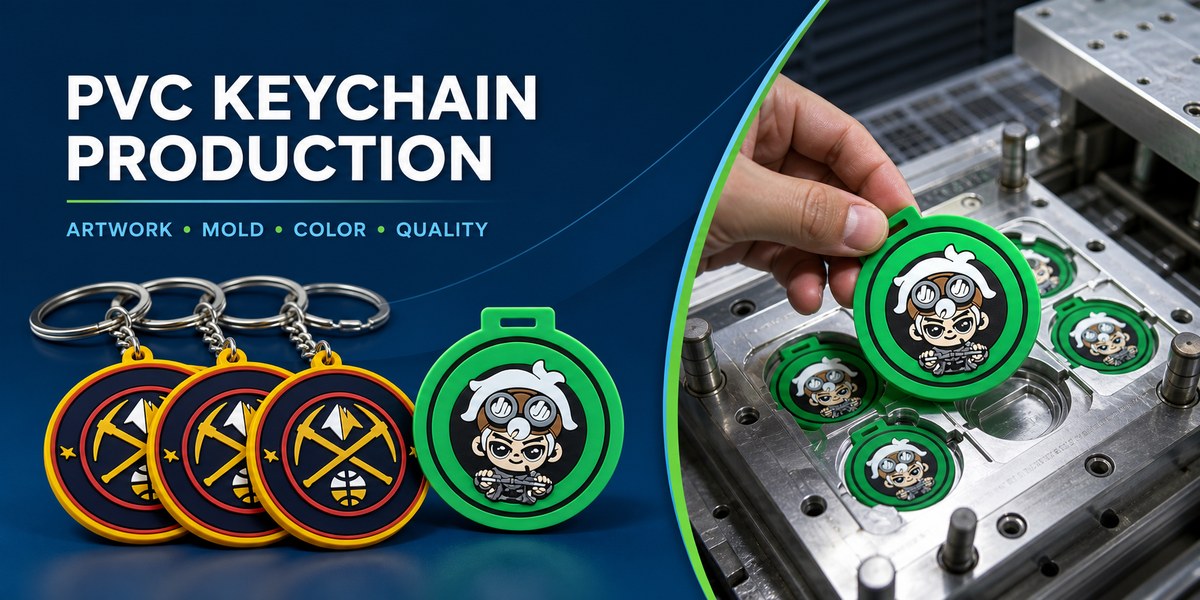
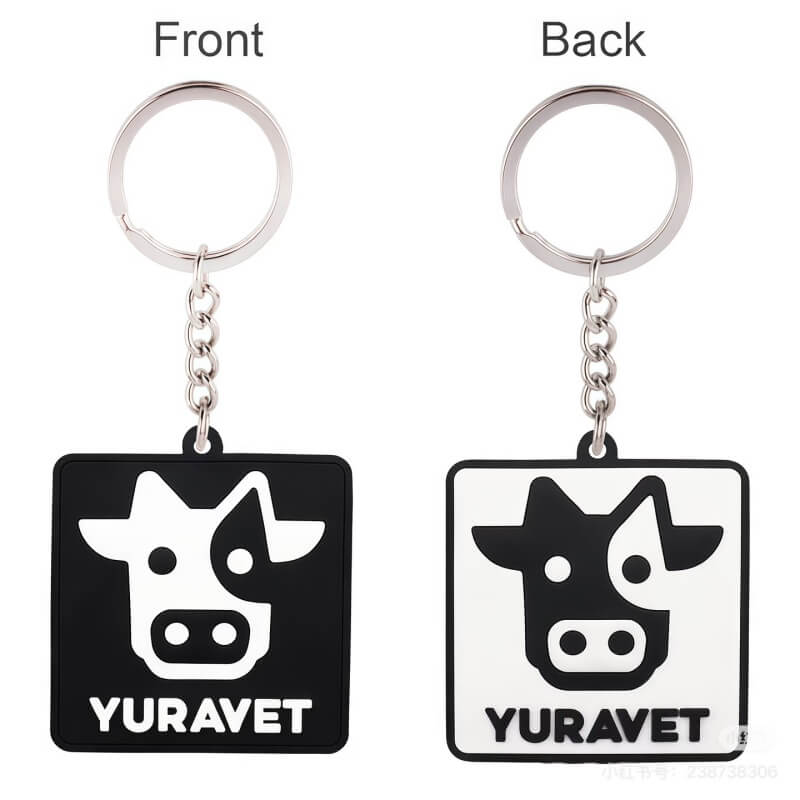
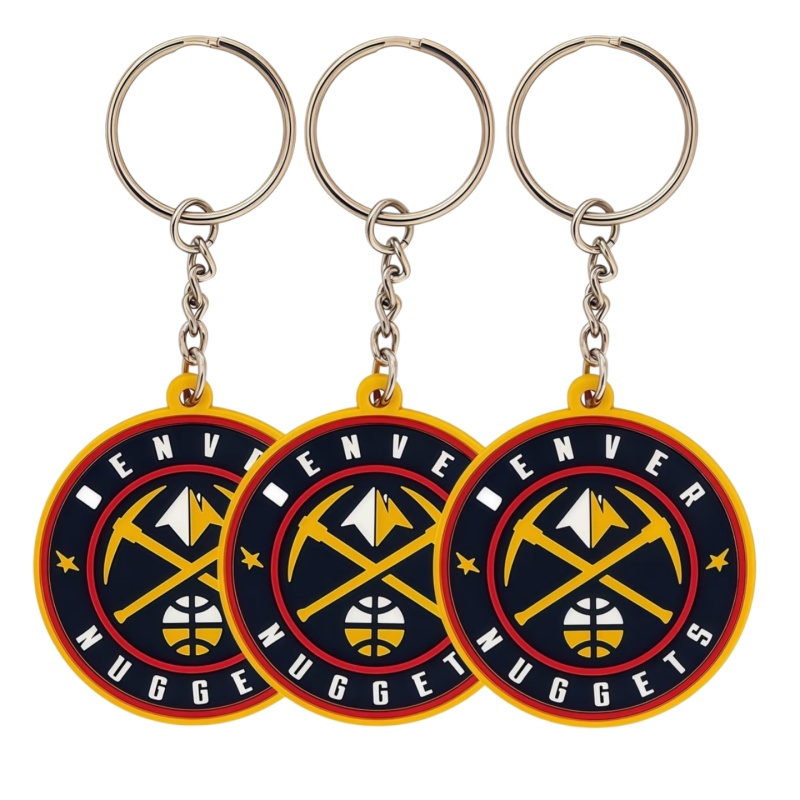
You send a flat piece of artwork, and a few weeks later a soft, colorful, three-dimensional keychain lands on your desk. Knowing what happens in between helps you brief your supplier better, judge a factory’s quality faster, and see where your cost and timeline really come from. This guide walks you through how PVC keychains are made, from your first file to the packed carton, and what each stage means for your order.
Our previous guide covered MOQ and mold pricing for every keychain material. This one breaks down the full PVC workflow, so you can trace the true source of your cost and lead time.
The PVC keychain process at a glance
| Step | What the factory does | Time |
|---|---|---|
| 1.Drafting | Turns your artwork into a 2D or 3D file | 1–2 days |
| 2.Mold cutting | Carves your shape into the mold | ~3 days |
| 3.Color mixing | Blends paste to hit each Pantone color | ~1 day |
| 4.Dispensing | Fills the mold with PVC, color by color | in production |
| 5.Baking | Heats the mold to set the PVC | in production |
| 6.Trimming | Cuts the flash edge off each piece | in production |
| 7.Checking | Inspects every piece | 1–2 days |
| 8.Packing | Fits the ring, then bags or boxes the order | 1–3 days |
The numbers behind a PVC run
Before the steps, here are the figures that shape your cost and schedule. These match the material data sheet from our earlier MOQ guide, so your numbers stay consistent across both articles.
| Spec | PVC keychain |
|---|---|
| MOQ | 100 pcs |
| Mold cost | from $120 (2D); more for a 3D shape |
| Mold-making time | ~3 days |
| Sample turnaround | 7 days |
| Unit price at 100 pcs (2D) | ~$0.80 |
| Unit price at 500 pcs (2D) | ~$0.45 |
| Free mold storage | 12 months (storage fee applies after) |
Look at the price gap. For the same 2D artwork, 100 pieces run about $0.80 each, while 500 pieces drop to about $0.45 each. Same mold, same design, but the fixed setup spreads over more pieces, so your unit cost falls as your quantity grows. (For MOQ and mold costs across metal, PVC, silicone, fabric, and plastic, see Custom Keychain MOQ Explained.
Step 1: Artwork and drafting
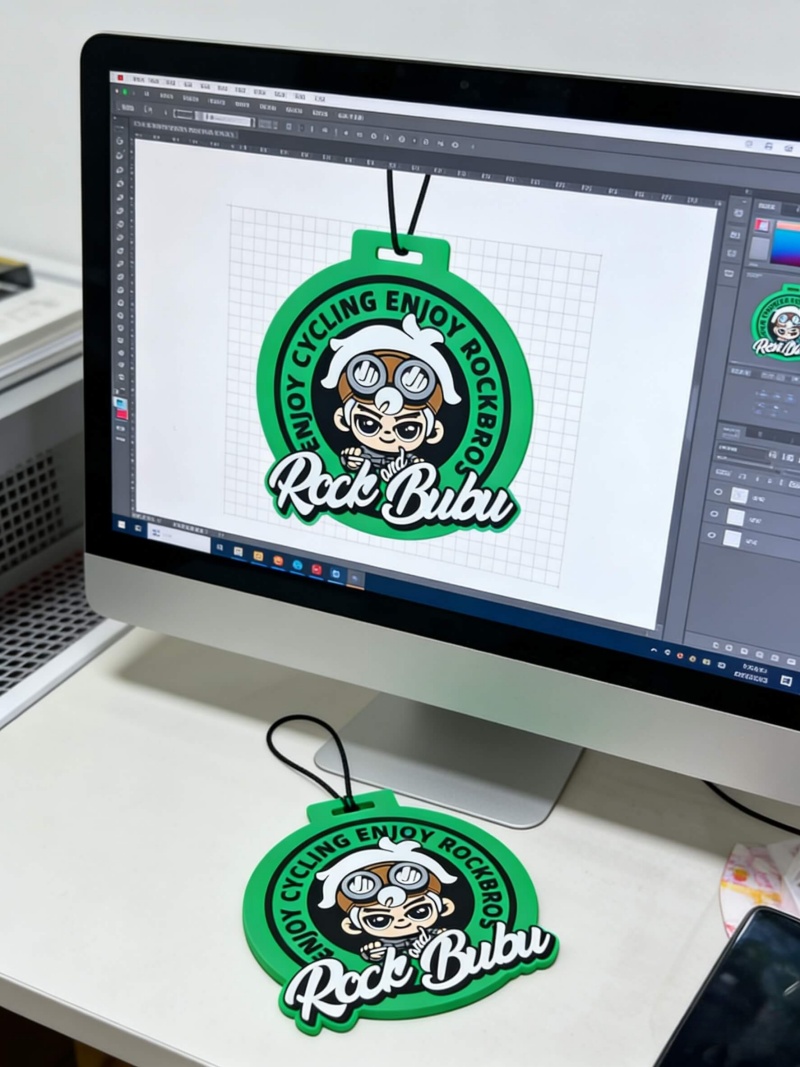
Everything starts with your design. You send your logo or artwork, and the factory turns it into a production-ready draft, either a flat 2D layout or a full 3D model. This is where your shape, size, and colors get locked in before any tooling begins.
Your result is only as good as your file. Send vector artwork if you can, and mark your exact colors. This is also the cheapest moment to change anything, since nothing has been cut yet.
Step 2: Mold engraving
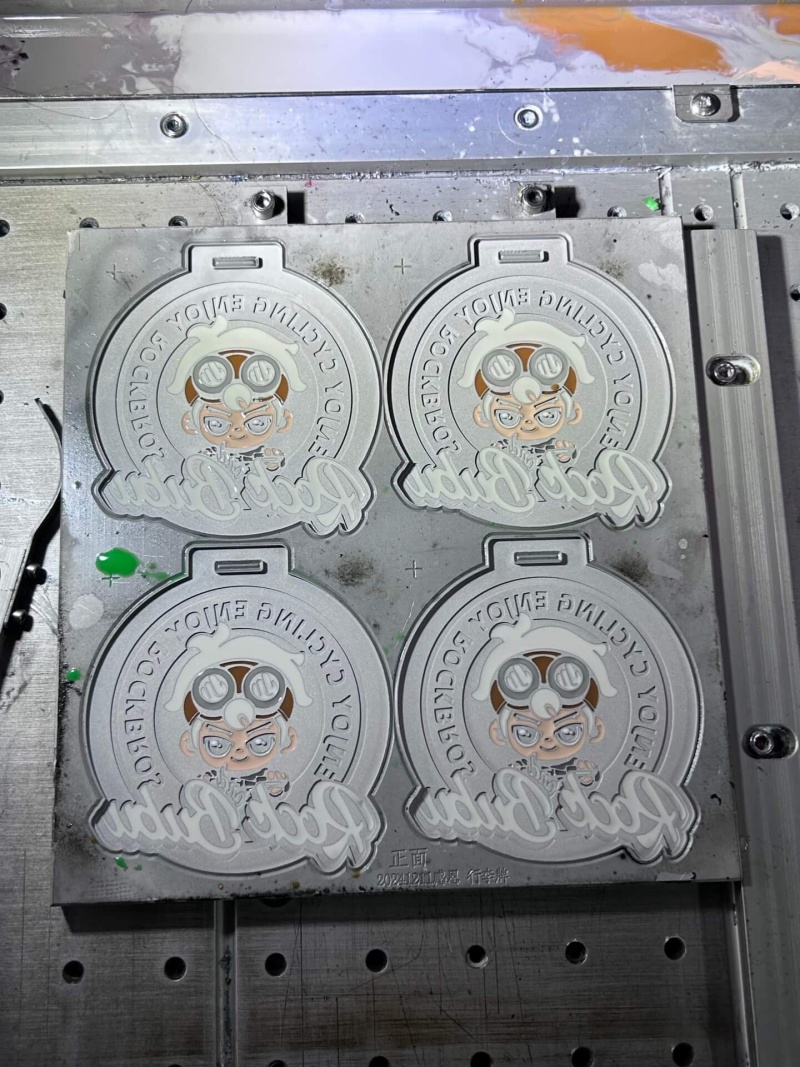
Once you approve the draft, your design is cut into a mold. The mold is the master tool that shapes every keychain, engraved from aluminum or steel depending on your run size. A flat 2D design needs a simpler mold, while a 3D shape takes more engraving to capture its depth.
This is your one-time tooling cost, and it decides how crisp your detail comes out. PVC mold charges and MOQs follow the material table in our earlier guide; a sculpted 3D mold costs more to tool than a flat 2D one.
Step 3: Color matching
Next, the factory mixes the color paste that fills the mold. Each color is matched by hand, ideally against the physical Pantone codes you provide. This step decides how close your keychain lands to your brand colors.
A careful factory holds color deviation to within about Grade 1 against a physical Pantone swatch. Very light or pastel shades can still shift up to around 5% during mass production, so confirm them on your sample first.
Pitfall to avoid: never approve colors from a screen. Ask for physical Pantone swatches, since a screenshot never matches molded PVC.
Step 4: Dispensing the PVC
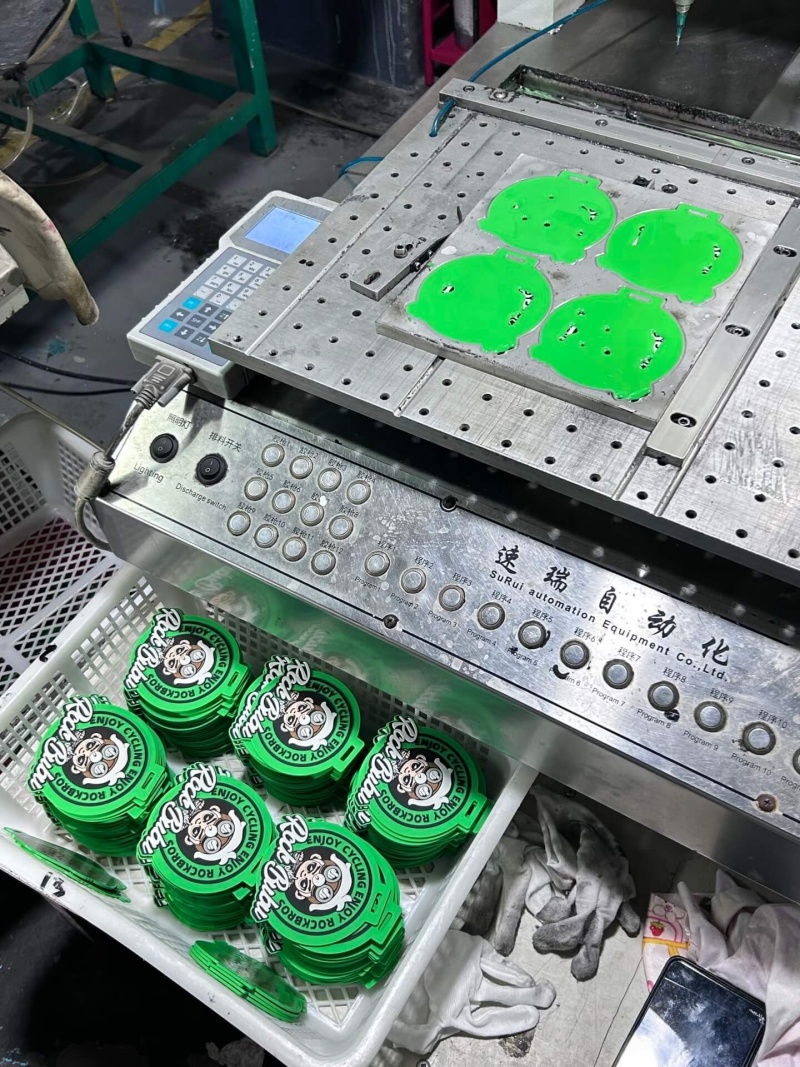
Now the keychain takes shape. Soft PVC and your mixed colors are dispensed into the mold cavity, filling it color by color. Fine detail is often done by hand for accuracy, while larger fills use a machine for speed. On a multi-color design, each color goes into its own section.
This is the most skill-dependent stage, and it is where detailed keychains are won or lost. Neat work gives you clean color lines. Rushed work gives you bleed and gaps.
Pitfall to avoid: on your sample, check the tiny color blocks for missing fills or bleeding before you approve the full run.
Step 5: Baking and molding
Once filled, the molds are baked at around 160–180°C for about 8 to 12 minutes to cure the soft PVC. After baking, the mold is cooled, clamped, hot-pressed, and cooled again so the keychain sets into its final shape. Only then is it removed.
This stage decides durability. Correct baking gives you a flexible, waterproof piece with no bubbles or warping. Under-baking or over-baking causes soft spots, deformation, or a short life.
Pitfall to avoid: agree the baking standard before you order, since a wrong setting can deform a whole batch.
Step 6: Trimming
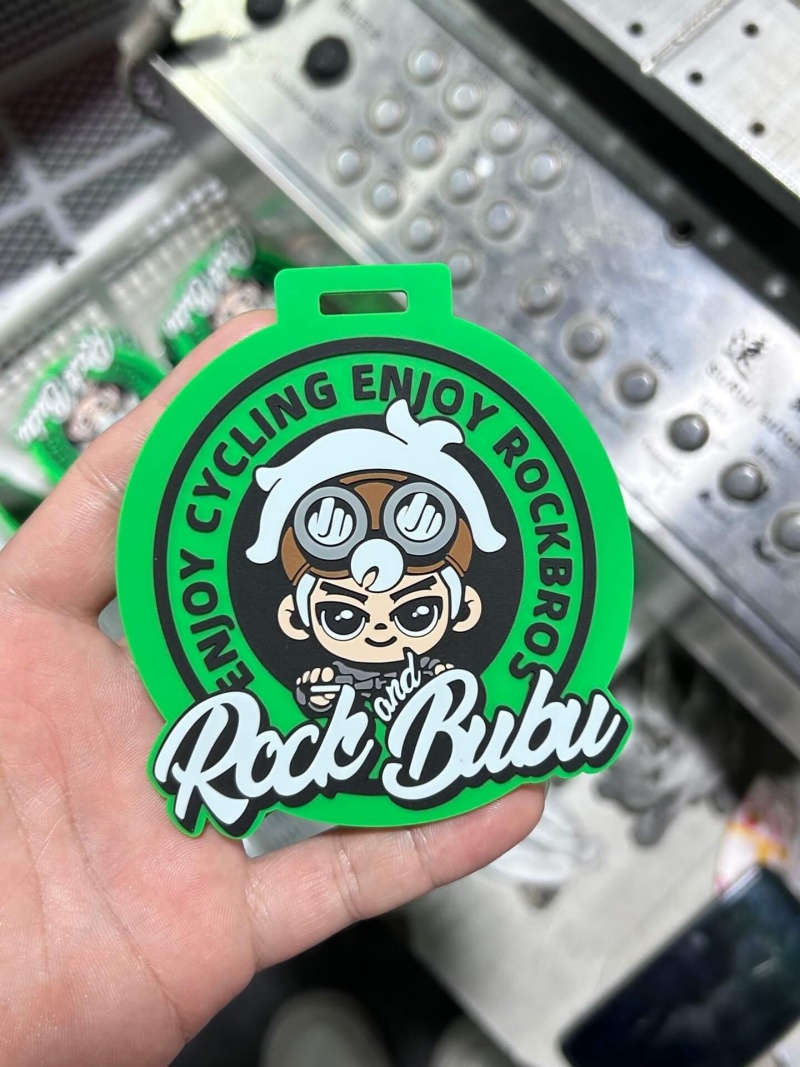
Fresh out of the mold, each keychain has a thin edge of excess material, called flash. Workers trim this away by hand for a clean, finished outline. It is a simple step, but a sloppy one leaves rough edges that cheapen the product.
When you check a sample, run your finger around the edge. Smooth means careful trimming. Rough means corners were cut.
Step 7: Quality control
Before anything is packed, the keychains are inspected. A good factory checks each piece for color accuracy, detail, surface defects, and a secure attachment. Anything off-spec is pulled out so it never reaches your order.
Ask your supplier how they run QC, because this invisible step protects your reorders and your reputation.
| Check | What it confirms | Pass mark |
|---|---|---|
| Color | Shade vs your signed sample | No visible shift |
| Shape | Mold detail, full and sharp | Nothing missing |
| Surface | Bubbles, marks, scratches | Clean face |
| Ring | Keyring fit | Holds firm, no pull-out |
A factory that inspects every unit ships a consistent batch, where piece number 500 matches the sample you signed off.
Step 8: Assembly and packing
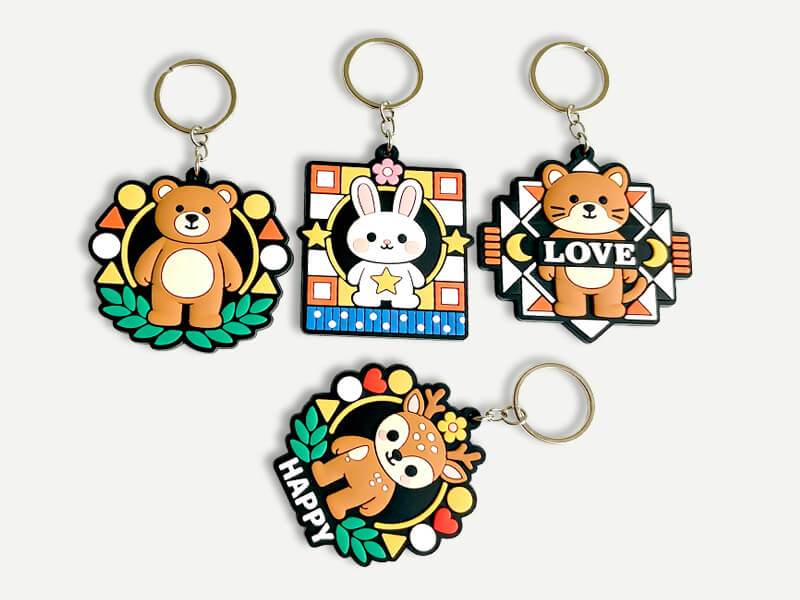
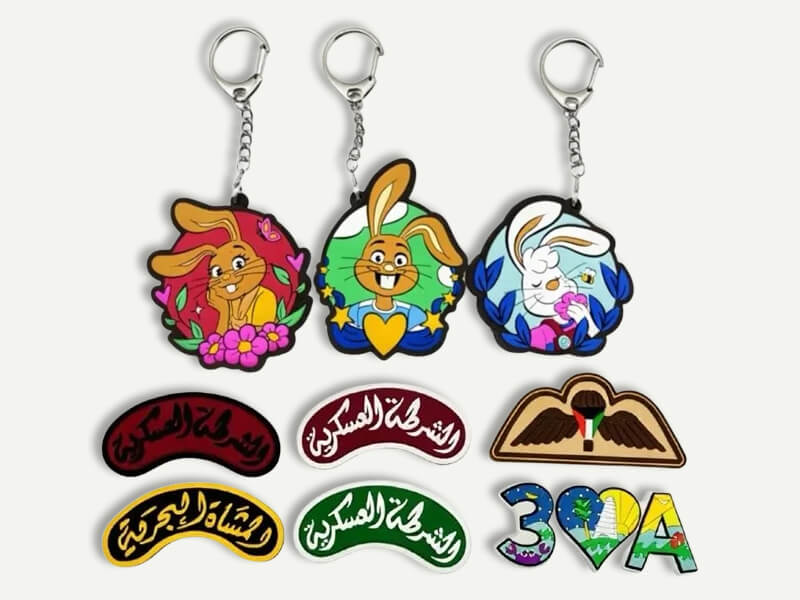
In the final stage, the keyring, chain, or clasp is attached, and your order is packed. Packing runs from a simple polybag to a retail-ready backing card or gift box. If you sell in stores, this is where barcodes and branded packaging get added.
Tell your supplier your packing needs early, because they affect both your cost and your lead time. Ready-to-shelf packaging takes more prep than a plain bag.
How long does the whole process take?
A custom run moves through drafting, mold making, sampling, production, and packing, then shipping on top. A new PVC mold takes about 3 days, and existing stock styles skip the mold stage, so they move fastest.
Lead times for a new PVC mold follow the data sheet in our previous guide. Ready-made stock styles with no new mold ship in about 3 to 5 days. Share your deadline at the start and confirm the full schedule before you approve your sample.
In-house mold factory vs an outsourced middleman
Where your mold is cut changes your price, your speed, and how fast problems get fixed. A factory with its own mold shop controls the whole job. A middleman sends the tooling out and adds a markup on top.
| Point | In-house mold factory | Outsourced middleman |
|---|---|---|
| Mold-making time | Faster, done on site | Slower, sent out |
| Mold charge | Direct factory cost | Marked up |
| Revision turnaround | Quick, same building | Slow, back and forth |
| Defect handling | Fixed on the line | Passed between parties |
For repeat orders, the in-house route saves you both money and time.
Production plans for different buyer groups
Your best production plan depends on the kind of buyer you are.
- Startup and small sellers (100–300 pcs): Reuse an existing mold and go with a flat 2D design. Add multi-color options on one mold to get variety without new tooling, and test the market at low cost.
- Corporate and event gifts (300–800 pcs): Use simple 3D designs for a premium feel, approve your sample in stages, and flag a tight deadline early so production can be prioritized.
- Large wholesale buyers (1,000 pcs+): Invest in a new sculpted 3D mold, keep it in long-term storage for reorders, and ask about tiered volume pricing as your quantity climbs.
Ways to keep a small mixed order affordable
Mixing totally different shapes does not waive the tooling, since each new shape still needs its own mold. But you do have real workarounds:
- Split the mold fee across a few designs, so you can run a small assorted order instead of one big batch.
- Combine your designs into one consolidated shipment to share the international freight cost.
Common PVC defects: prevention and after-sales
Even a good factory can hit a fault. Knowing the five common ones, and how they are handled, protects your order.
| Defect | How to prevent it | After-sales fix |
|---|---|---|
| Color deviation | Approve physical Pantone swatches | Rework or remake to the signed sample |
| Bubbles | Confirm the baking standard | Faulty pieces replaced |
| Excess flash | Check edges on the sample | Re-trimmed or remade |
| Deformation | Lock the baking parameters | Batch remade |
| Blurry pattern | Approve a clear sample first | Mold revised, pieces reprinted |
Before you order, agree the rework rules in writing: whether mold revisions are free after a confirmed sample, the replacement lead time for faulty goods, and any charge for changing the mold later. A supplier that sets this out clearly is easier to trust.
How to get a better keychain from the process
You have more control over the outcome than you might think. A few simple habits lead to a cleaner result:
- Send vector artwork so your detail survives the mold.
- Provide physical Pantone codes so your colors land accurately.
- Choose 2D for the simplest, lowest-cost setup, or 3D for depth and impact.
- Always approve a physical sample before the full run.
- Confirm packing and deadline before production starts.
Do these, and you remove almost every reason a first order goes wrong.
One-stop customization with a source factory
Now that the process is clear, here is what a source factory brings to it. You buy direct from the manufacturer, not a middleman who marks up the price, so quality stays consistent from the first unit to the last.
- In-house mold workshop — faster tooling and tighter quality, all under one roof.
- BSCI-certified plant — a 2,000 m² factory with 15 years of custom PVC experience.
- 1,000+ in-stock styles — brand a ready design with no new mold cost.
- Free design and free samples — see your keychain before you commit.
- 12-month free mold storage — reorder without paying for tooling again.
- Full in-house production — every stage handled in one place.
It is the kind of source factory built for repeat orders, not one-off runs.
Pop it Keychains
- Silicone or PVC materials available, eco-friendly and non-toxic
- Pest Control Pioneer with pressure-relief design
- Supports customisation of shape, colour and logo
- Free samples provided
PVC Shoes Keychain
- MOQ: 100pcs for stock designs, 300pcs for custom molds
- Price Range: $0.80-$3.50/pc (based on quantity, size, complexity)
- Sample: 3-5 days, Bulk: 7-10 days (rush order available)
- Phthalate-free & BPA free,CPSIA/Prop65/REACH
FAQ
How are PVC keychains made?
Your artwork is drafted, a mold is engraved, colors are matched, then soft PVC is dispensed into the mold, baked and pressed to set the shape, trimmed, checked, and packed. Every keychain goes through each stage.
What is the difference between 2D and 3D keychain production?
A 2D keychain uses a flat mold and a simpler fill. A 3D keychain needs a sculpted mold and more detailed dispensing, so it costs more and takes more work.
How are the colors put into a PVC keychain?
Color paste is mixed to your Pantone shades, then dispensed into each section of the mold by hand and machine. That is why PVC handles bright, multi-color designs so well.
What is flash, and why does trimming matter?
Flash is the thin excess material left around a molded piece. Trimming removes it for a clean edge, and neat trimming is a clear sign of a careful factory.
How do you adjust a flawed sample?
Tell the factory exactly what is off, such as color, detail, or size. The mold or color is corrected and a new sample is sent before the bulk run starts.
How is a color mismatch fixed in a bulk order?
If a confirmed batch does not match your signed sample, a reliable factory reworks or remakes the faulty pieces and resends them. Agree this rule before you order.
How long is my mold stored for free?
Molds are commonly stored free for around 12 months so you can reorder without new tooling. A storage fee may apply after that, so confirm the exact term.
Can I split mold fees across mixed designs?
Sometimes. Some factories share a partial mold cost across a few designs so you can run a small assorted order. Ask whether this is possible for your set.
How long does it take to make custom keychains?
A new PVC mold adds about 3 days, samples take around 7 days, existing styles ship in 3 to 5 days, and production scales with quantity. Confirm the full timeline before approving your sample.
Ready to start? Send your artwork, colors, and quantity, and get a free design, a free sample, and a clear quote back. Contact the HuaSan team to take your keychain from artwork to finished product.