
Send the same design to three factories and you can get three very different numbers back — and the gap usually isn’t one supplier padding the price, it’s each one bundling a different set of costs into that single per-piece figure.
A custom fridge-magnet quote usually combines several cost drivers. This guide covers nine common ones — but the dominant factor depends on your drawing, process route, quantity, quality requirements, packaging, destination, and trade term, and a quote can also include costs this guide doesn’t cover in detail, like design engineering, sample revisions, fixtures, scrap allowance, inspection, testing, licensing, or exchange-rate effects. Compare suppliers only after you’ve aligned those inputs — a lower number on a different spec isn’t actually a lower price.
Breaking the number apart does two things: it shows you which factor is actually driving your total, and which one to change if the price comes back too high.
1. Tooling or Setup Charge: Often the Biggest First-Order Variable
A mold or cutting die turns your drawing into a physical tool. You typically pay for it once, and it can lower the cost of every piece made from it afterward.
Whether you pay this, and how much, depends on process route more than material name alone:
- Moulded soft PVC, cast resin, and die-cast metal generally need a dedicated mold — new outline, new mold.
- Stamped or etched metal typically needs a die or fixture — a different cost than a full injection mold, but still a setup charge.
- Cut-and-printed acrylic and laser-cut wood often skip a mold, since a supplier cuts the shape rather than moulding it — but complex cutting can still need a program, fixture, or minimum setup charge, so don’t assume zero tooling without asking.
- Flexible magnetic sheet is usually printed and die-cut, which can also carry a cutting-die or setup charge depending on the shape.
On a small order, a tooling or setup charge can dominate the total; at high volume, it typically becomes a smaller share of the unit price. Exactly where that shifts depends on your specific mold cost, unit price, and quantity — ask your supplier for pricing across a few quantity tiers rather than assuming a round number.
Two questions worth asking any supplier: does the tooling or setup charge appear as its own line, or is it folded into the unit price? And who owns the tool afterward, and what happens if you move production to a different supplier later? A mold-fee and production-process guide written for a related custom product explains the general tooling-cost logic — only the underlying principle transfers to magnets, not the specific numbers.
2. Material: A Major Price Lever, Not a Fixed Ladder
Material choice generally moves your quote more than most other single factors — but the order from cheapest to most expensive can shift with size, process route, and quantity, so verify any general ranking against your own drawing.
For what each material actually is, how it’s produced, and which projects it suits, see the fridge magnet material guide — this section covers only how material choice moves the number on your quote.
Don’t pick material on price alone. A cheap magnet in a shop selling premium souvenirs doesn’t save money — it can cost the sale. Match the material to what your buyer expects to pay, then optimise cost inside that choice.


3. Size and Thickness: Direction Is Predictable, Magnitude Isn't
Larger and thicker pieces generally cost more, since they use more raw material across the run — but exactly how much more depends on your process, material yield, and how your supplier prices it, so ask for the actual cost difference on your specific drawing rather than assuming a flat rate per millimetre.
Thickness can also change your magnet requirement: a heavier piece often needs a stronger or larger magnetic backing, which typically costs more than a lighter-duty option.
Check your dimensions before requesting a quote. Buyers sometimes round up to a comfortable size without testing whether a smaller one holds up just as well on a fridge door — a size reduction on a large order can sometimes save more than a material change, but only your supplier’s actual numbers can confirm that for your design.
4. Colour Count: Direction of Cost Depends on Process
More colours generally add cost, but how much — and how it scales — depends on the process, not a fixed rule:
- Moulded PVC typically fills each colour in a separate step, so more colours can mean more labour — but the actual impact depends on your mold design and how your supplier separates the colours in it, not colour count alone.
- Enamel-filled metal works similarly — more individually filled colour areas generally add labour — though the total also depends on the size and complexity of each area.
- UV or digital printing on acrylic generally scales differently, since many machines print multiple colours in a similar number of passes — a complex, many-colour design can sometimes cost close to a simpler one on the same process, but ink coverage, white-ink or varnish layers, and rework rates all affect the real number.
Special finishes — epoxy dome coating, 3D relief texture, glitter, glow-in-the-dark pigment, metallic plating — typically add a processing step, and each added step typically adds cost. Ask your supplier to quantify the actual cost impact of colour count and finishes against your final artwork rather than relying on a general rule.


5. Production Process: Setup-Heavy vs. Labor-Intensive Steps
This factor explains a lot of the gap between quotes, but it’s more nuanced than “machine work is cheap, hand work is expensive.”
Automated steps — printing, cutting, moulding — still involve setup, changeover, inspection, and some labour, and they don’t automatically get cheaper at any volume; the actual per-piece cost depends on your supplier’s bottleneck, yield, and capacity at your order size.
Manual or semi-manual steps — hand-painting resin detail, hand-filling enamel colours — tend to scale less with volume than a fully automated step, since a person doing the same motion on piece 5,000 generally doesn’t get much faster than on piece one. How much this flattens your price curve still depends on how much of your specific design needs manual work versus how much runs through automated steps.
Ask your supplier which steps in your specific design are setup-heavy versus genuinely labor-intensive, and ask for tiered pricing across a few quantities — that tells you whether ordering more will actually bring your unit price down, rather than assuming it always will.
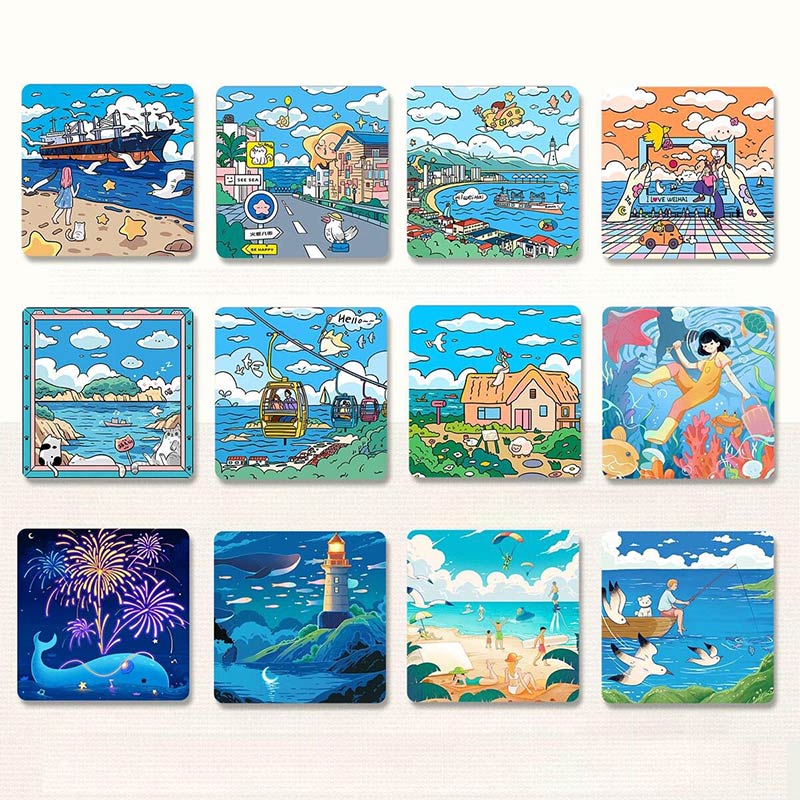
Coastal Cartoon Square Magnets
A compact printed format for colorful destination and souvenir programs.
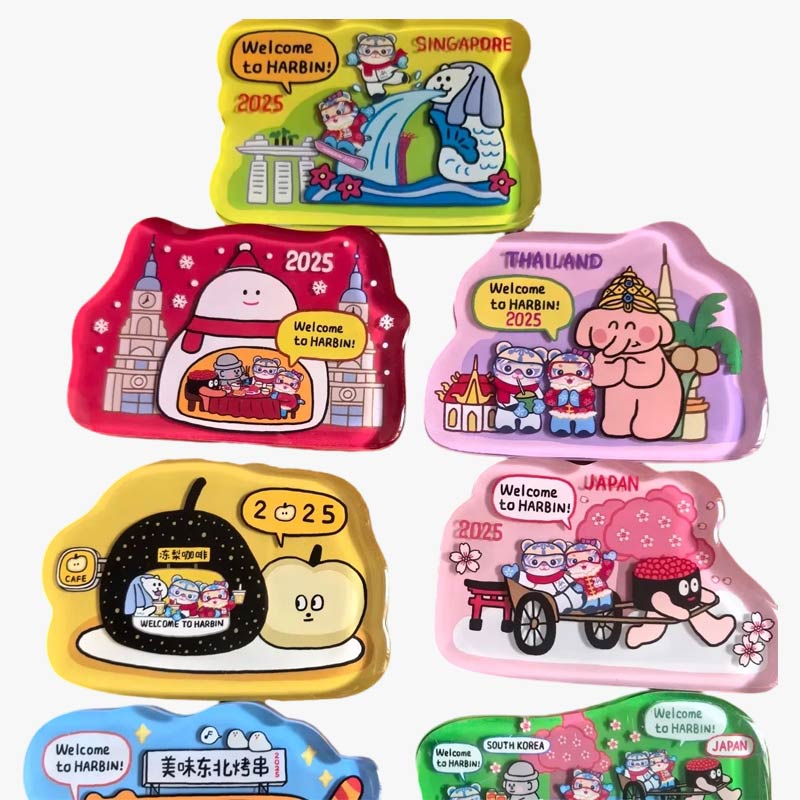
Cartoon Acrylic Travel Magnets
Acrylic supports detailed full-color artwork without a dedicated mold.
6. Magnet Construction: More Than a Grade Choice
The magnetic backing is often a small share of total cost, and it moves the number in both directions: a heavier front generally needs a larger or stronger backing, which costs more, while over-specifying it means paying for holding power the piece doesn’t need.
Because suppliers price the backing by construction rather than by a single grade name, ask your supplier to quote the complete specification — material type, dimensions, thickness, and attachment method — so you can compare that line against another supplier’s. For how to define and test holding performance before approving it, see the supplier checklist.
7. Packaging: Depends on Your Channel, Not a Fixed List
Packaging can swing landed cost more than buyers expect, and it scales from a plain polybag up through printed header cards, backing cards with barcode and hang hole, blister packs, printed gift boxes, and multi-piece sets — each added step typically adds cost.
Two effects are easy to miss: retail-ready packaging generally adds shipping volume, which can raise freight cost per piece even though the magnet itself hasn’t changed; and more complex packaging generally adds hand-assembly labour.
What you actually need depends on your channel and destination, not a universal rule — confirm barcode format, country-of-origin marking, hang-hole placement, and any language requirements with your importer or retailer, since these vary by market and by retailer program. List these fields explicitly in your RFQ rather than assuming a default.

For channel-specific presentation choices, see HuaSan’s custom-product packaging requirements guide.
8. Order Quantity: Generally Works in Your Favour, With Limits
Quantity is the one factor on this list that generally reduces cost rather than adding it, though the size of the benefit isn’t linear and depends on your specific tooling and process.
As order size grows, a tooling or setup charge typically spreads across more pieces, material may be bought in larger lots at a better rate, and fixed setup time divides across more units — all of which can lower unit price. Early volume increases often produce a bigger unit-price drop than later increases of the same size, because you’re amortizing tooling and setup costs fastest early on — but the exact curve depends on your process and supplier, so ask for tiered pricing to see where it actually levels off for your design.
One caution regardless of the curve: ordering a large batch of an untested design to chase a lower unit price is a risk in itself — a cheap magnet nobody buys costs more than a pricier one that sells. Testing small with a no-mold material first, then scaling once the design is proven, is generally lower-risk.
Always ask for the MOQ on your exact design rather than a number from a homepage — minimums shift with shape complexity, material, and tooling requirements.
9. Shipping, Duties, and Trade Terms: Where Factory Price Becomes Landed Cost
Factory price and landed cost are different numbers, and the gap surprises a lot of first-time importers.
Weight matters — metal and resin magnets generally weigh more than PVC or acrylic, and on a large order that weight difference can add more to freight than it saved on unit price. Beyond weight, sea freight pricing isn’t simply “per kilogram and always cheaper than air” — LCL (less-than-container-load) shipments carry minimum charges and are often billed on chargeable weight, which factors in volume as well as actual weight, so get an actual freight quote rather than assuming a flat per-kilo rate. Air generally suits samples, urgent replenishment, or small high-value orders; sea generally suits larger volume — but confirm the actual numbers with a forwarder rather than assuming.
Duties and taxes apply on top of the factory price. Your rate depends on your country and your HS code classification — confirm that code with your own customs broker rather than assuming your supplier’s code applies to your import, since misclassification can cause delays that cost more than the duty itself.
Use a named Incoterm from Incoterms® 2020, plus a specific place or port — “EXW” or “FOB” alone isn’t a complete term. FOB technically applies to sea or inland-waterway shipment with cargo loaded directly onto a vessel; for containerized cargo handed to a carrier before vessel loading, FCA is often the more precise term under Incoterms 2020. DDP shifts import clearance and tax responsibility to the seller, which changes who’s responsible for compliance at your border — confirm exactly what’s included before treating two quotes on different terms as comparable. Ask every supplier to quote the same named term so you’re comparing the same scope of responsibility, not just a number.
For export documentation and shipment planning, use the international shipping and customs preparation guide.
Cost Factor Reference
| Factor | What to Give Your Supplier | Cost Type | What You Can Do | Ask Your Supplier For |
|---|---|---|---|---|
| Tooling / setup charge | Final drawing, process route | One-time | Compare per-mold cost across quantity tiers | Tooling cost, ownership terms, minimum setup charge |
| Material | Target price point, market | Per-unit | Match material to buyer expectation, then optimise | Per-unit price at your actual quantity |
| Size and thickness | Exact dimensions | Per-unit, compounds with volume | Test whether a smaller/thinner spec still performs | Cost difference between size options |
| Colour count and finishes | Final artwork, colour breakdown | Per-unit, process-dependent | Simplify colours where the design allows | Cost impact of your specific colour count |
| Production process | Design detail level | Per-unit, may not scale with volume | Ask which steps are manual vs. automated | Tiered pricing at several quantities |
| Magnet construction | Finished weight, target surface | Small per-unit cost, high consequence if wrong | Approve via a repeatable holding test | Full backing spec, not just a grade name |
| Packaging | Sales channel, destination market | Per-unit and logistics | Match packaging to actual channel | Itemized packaging cost and requirements |
| Order quantity | Target volume, or a range | Reduces most per-unit and one-time costs | Get tiered pricing before committing to a number | MOQ for your exact design |
| Shipping, duties, trade term | Destination, target ship method | Logistics, weight- and volume-driven | Compare quotes on the same named Incoterm | Chargeable weight/volume, duty rate, importer-of-record terms |
Every cell above depends on your specific drawing, quantity, and destination — use this table to know what to ask for, not as a price list.
Ways to Influence Cost Without Cutting Quality
- Review your colour count. Reducing colours on a PVC or enamel design can lower cost meaningfully, and many logos read fine with fewer colours — ask your supplier to quantify the actual saving for your design.
- Check your dimensions. Ask whether a thinner or smaller spec still performs on your target surface before defaulting to a bigger number.
- Test with a no-mold material first. Proving a design in acrylic or flexible magnetic sheet before committing to a mold reduces the risk of an expensive, untested tool.
- Match packaging to your actual channel. Don’t pay for retail-ready packaging if a distributor repacks the product anyway.
- Consolidate shipments where you can. Combining designs into fewer, larger shipments generally costs less than several small ones, though the actual saving depends on your volumes and routes.
Request an Itemized Quote
Share your artwork or a rough sketch, approximate size, quantity (or a range), and where you’ll use or sell the magnets. Ask for the quote broken out by tooling/setup fee, unit price, magnet construction, packaging, sample cost, and lead time, on a named Incoterm — so you can compare it against any other quote on the same basis.
Pricing and Quote FAQs
Why do three suppliers quote such different prices for the same design?
Check what each quote actually includes before comparing. One may bury the tooling fee in the unit price while another lists it separately; one may quote a basic magnet while another specs something stronger; packaging, sample cost, and Incoterm can all differ too. A low number with nothing itemized usually means something’s missing, and you tend to find it later.
What should a proper quote show you?
Ask for tooling/setup fee, unit price, magnet construction, packaging spec, sample cost, carton dimensions and gross weight, MOQ for your exact design, lead time, and a named Incoterm — all separated out. If any of those sit inside one blended figure, ask for the breakdown.
Does the sample cost count against your order?
Ask directly — policies vary by supplier, and it’s a fair question to ask before you pay for a sample. Get the answer in writing rather than assuming either way.
How do you avoid hidden fees?
Get everything in writing before a deposit: whether the price includes packaging, whether the supplier charges separately for artwork or design work, what a revised sample costs, and who pays for re-inspection if a batch fails. Confirm payment terms and what triggers the balance payment too.
Will unit price drop if you double your order?
Usually, though the size of the drop tends to shrink at higher volumes — the biggest gains often come early, while tooling and setup costs are still being spread across a smaller run. Ask for a tiered price list across a few quantities to see where the curve actually levels off for your design.
Can you get an accurate quote without finished artwork?
A rough sketch, approximate size, and quantity can get you a working estimate. A firm price generally needs final artwork, since colour count, shape complexity, and thickness all move the number.
Which costs more — a bigger magnet or a more complex one?
Depends on material and process. On PVC and acrylic, size often adds more cost than complexity, since you’re using more material. On metal and resin, complexity often adds more, since extra colour areas and detail tend to add labour that doesn’t scale away as easily.
Should duties factor into comparing quotes?
Yes — compare landed cost, not just factory price. A heavier material can cost more in freight than it saved on unit price, and duty rates depend on your country and HS code classification. Confirm the applicable rate with your customs broker before committing to a material.
What's a low-cost combination if budget is the main driver?
Generally: higher volume, a simple shape, fewer colours, a lower-cost material route like flexible magnetic sheet or soft PVC, simple packaging, and sea freight where the timeline allows. This combination tends to minimize cost — whether it fits your market and brand is a separate question worth answering first.