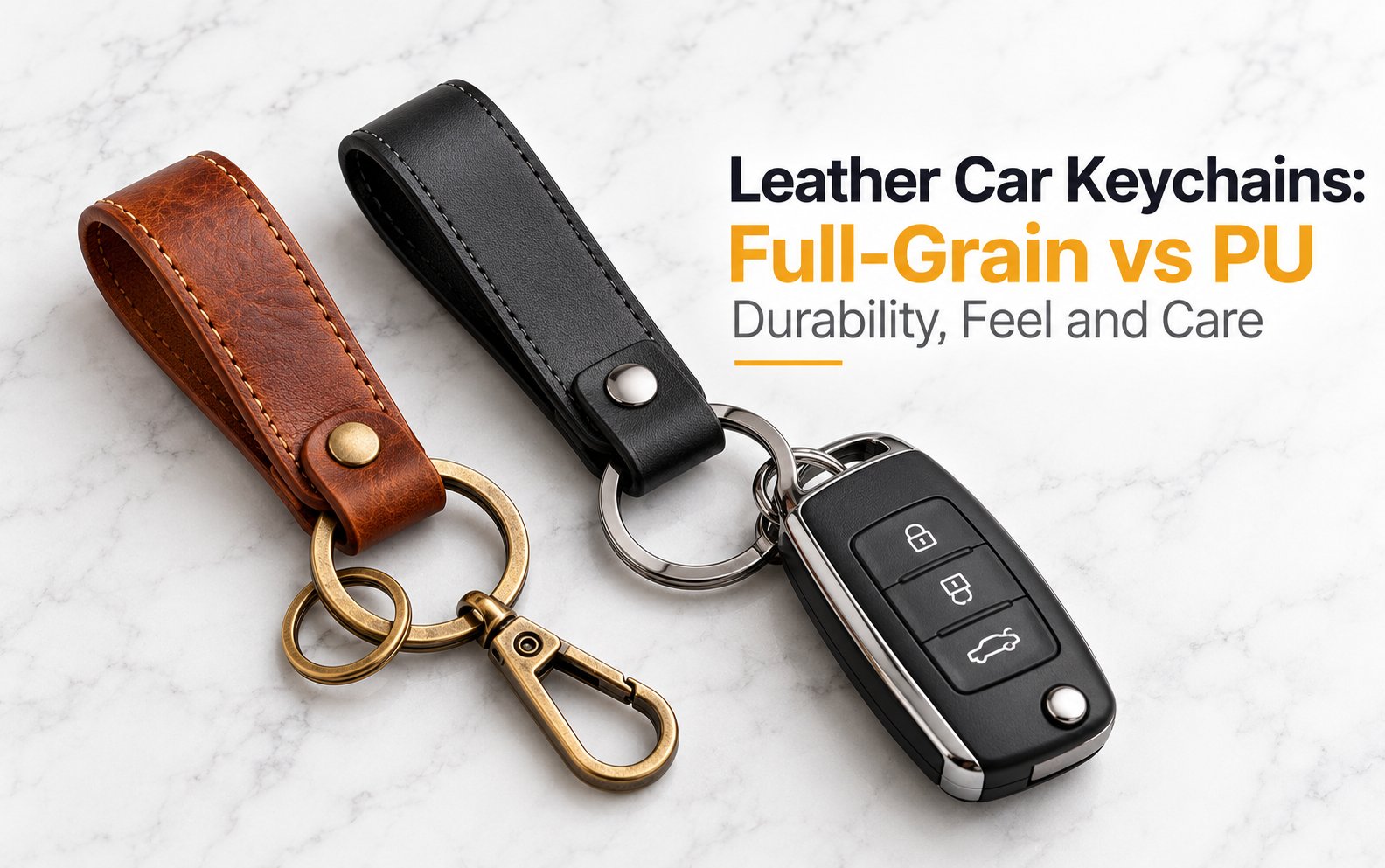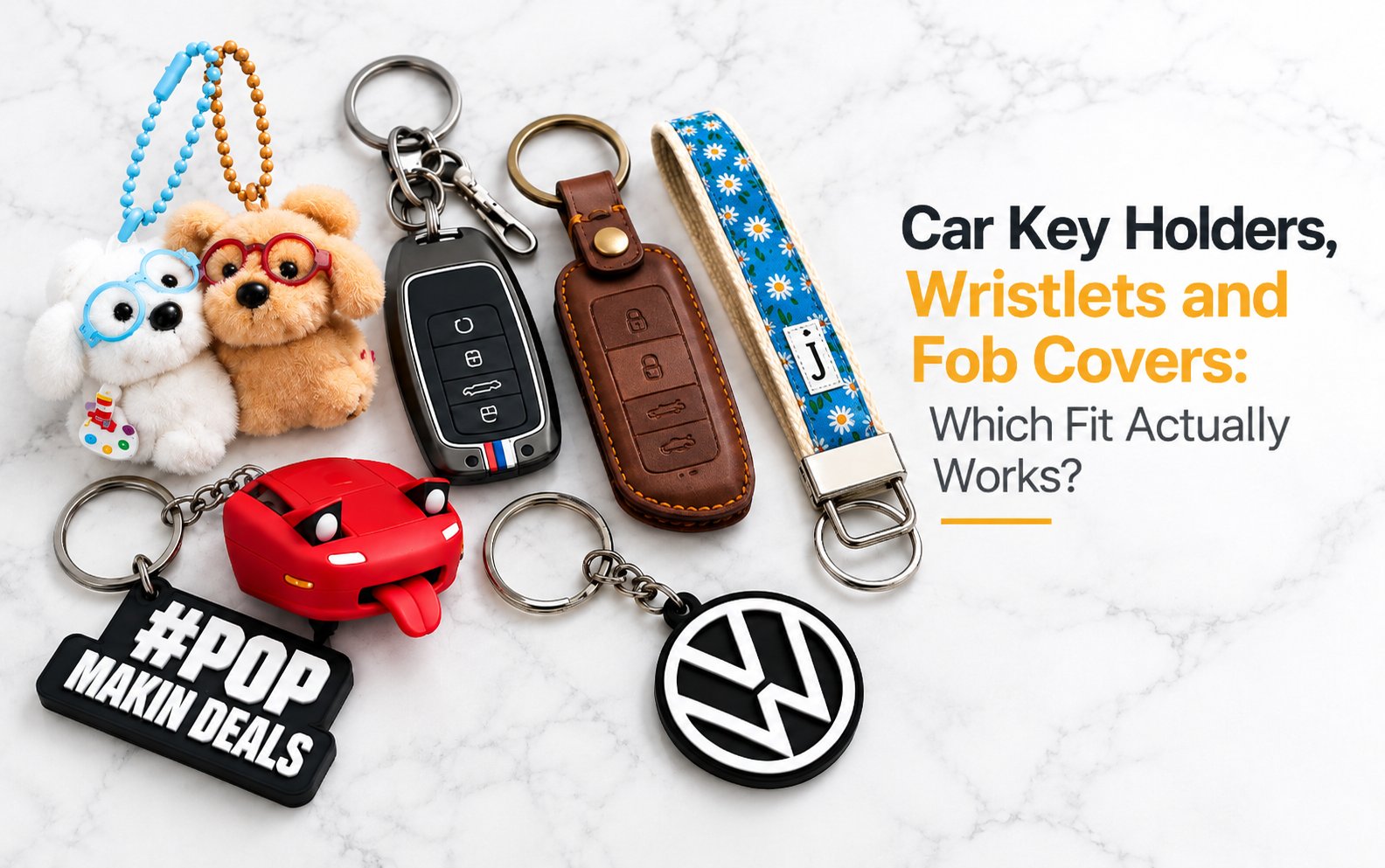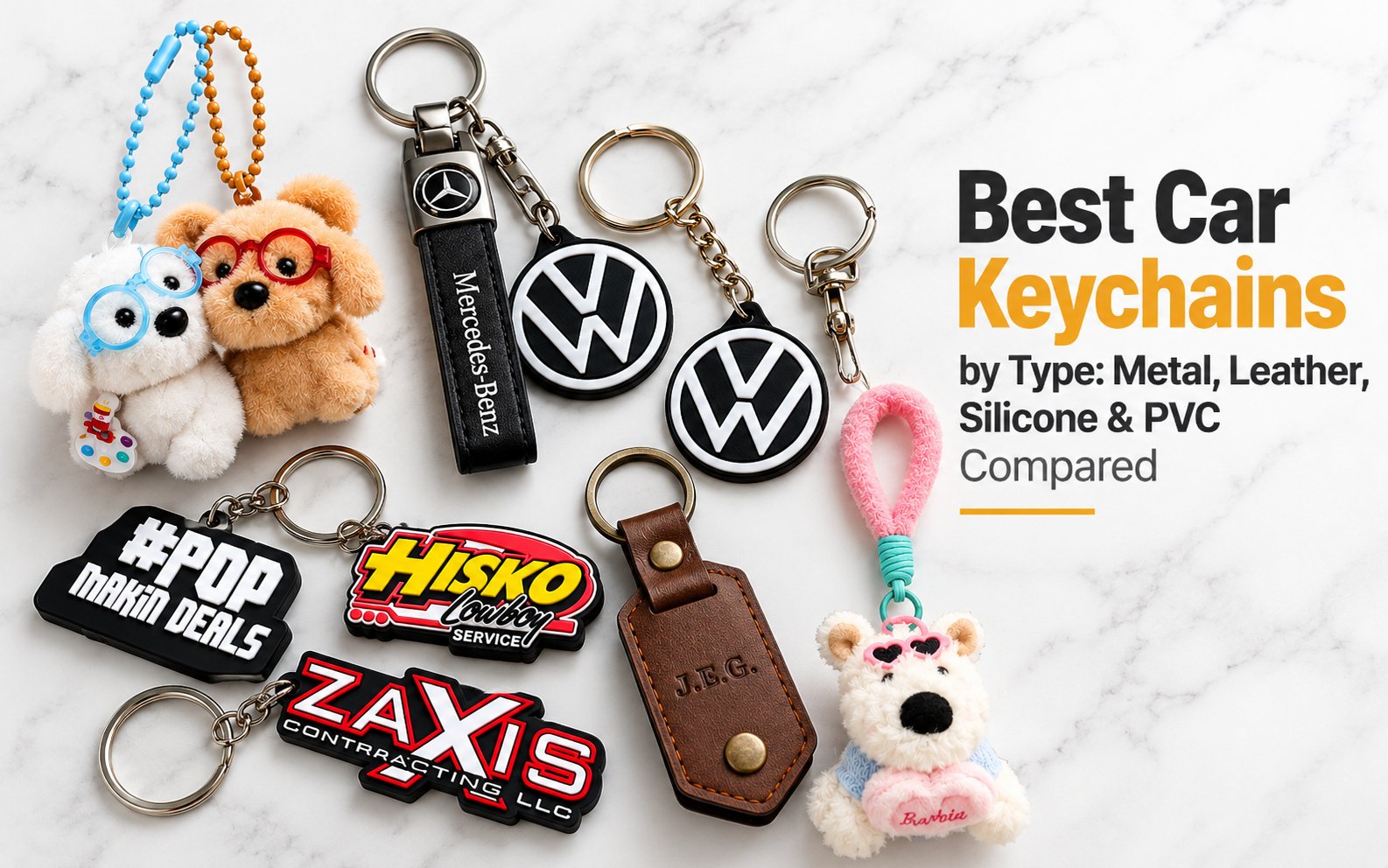
You run a dealership campaign. You need a keychain that carries your name, survives daily carry, and works alongside a modern key fob.
Two shapes compete for that job. A rubber strap keychain gives you a long printable tail. A standard rubber keychain gives you a compact charm on a split ring. Both are usually made from soft PVC. This guide compares them on shape, logo area, driver fit, hardware, and cost, not on two different materials.
Quick Answer
Choose a strap when you need a long readable logo area and room for a phone number. Choose a charm when you want the simplest tooling and the lowest cost per piece. A strap is a bigger part, so it normally costs more to mold and produce, and each shape needs its own mold. Confirm fit against the actual key system, ignition, smart fob, or fleet tag, before you commit to a quantity.
Compare These Six Things
| Criterion | Rubber strap | Standard rubber charm |
|---|---|---|
| Shape | Long and narrow, lies flat | Compact, often thicker |
| Usable logo area | Continuous length, fits a name and a phone number | Small enclosed face, best for a mark |
| Hardware | Often a larger ring or snap hook | Usually a standard split ring |
| Tooling | One mold, larger part | One mold, smaller part |
| Cost per piece | Higher, more material and fill area | Lower |
| Best for | Text-heavy branding, daily carry | Shape-led branding, high-volume giveaway |
Exact dimensions, weight, and ring sizes depend on your design; confirm them on a signed spec before production.
Fit the Shape to the Key System First
Check this before cost or MOQ, since it decides whether the piece works at all.
A conventional ignition key carries the keychain's weight and swing while the car moves. A smart fob usually rides in a pocket, so bulk matters less than whether the piece stays attached and legible. A fleet or valet tag needs to survive handling by people who did not choose it, and may need a clear ID rather than a long message.
Confirm weight, length, and movement against your target key system, keep the piece clear of controls, and follow the vehicle manufacturer's guidance rather than assuming one size is universally safe. Order a sample and hang it on a real key before you approve production.
Approve the Size on a Real Sample, Not a Drawing
A strap having "more space" only matters if the text is actually readable.
Ask for the sample to confirm overall length, width, thickness, finished weight, text height, and eyelet thickness in writing. Print your artwork at 1:1 scale and check it at normal hand distance before you approve the mold. This catches an oversized message or an eyelet that looks fine on screen and thin in hand.
What "Rubber" Means Here
In many promotional listings, "rubber keychain" means soft PVC. Confirm the material on your quotation rather than assuming. Four materials sit behind that word:
Soft PVC. Made flexible with plasticizers. The standard promotional keychain material.
Silicone. A separate polymer with a softer feel and better heat resistance.
Natural or synthetic rubber. A different material class, rarely used for printed promotional keychains.
Metal. Zinc alloy or steel, usually with enamel and plating.
Our soft PVC safety guide describes the material's rubber-like feel, molded colour areas, and raised or recessed detail. Our PVC, silicone and metal comparison rates PVC as waterproof, flexible, and able to capture fine 2D or 3D detail at the lowest unit cost; silicone as softer with better heat resistance but suited to less intricate designs at mid-range cost; and metal as the hardest and longest lasting, at the highest cost.
For a high-volume auto campaign in colour, soft PVC usually wins on cost. The decision that actually changes your outcome sits one level down, in the shape.
Shape: Strap or Charm
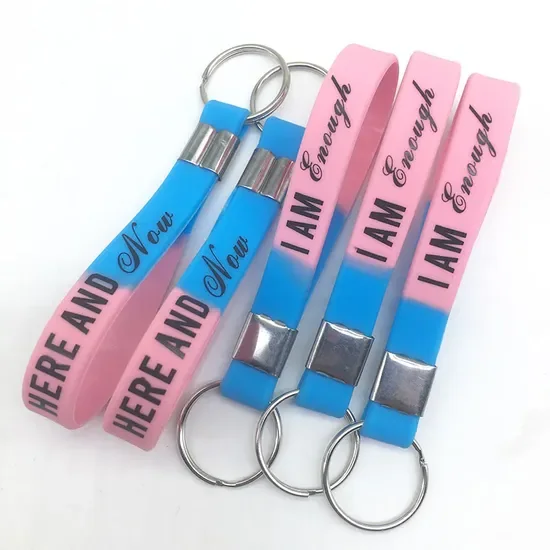
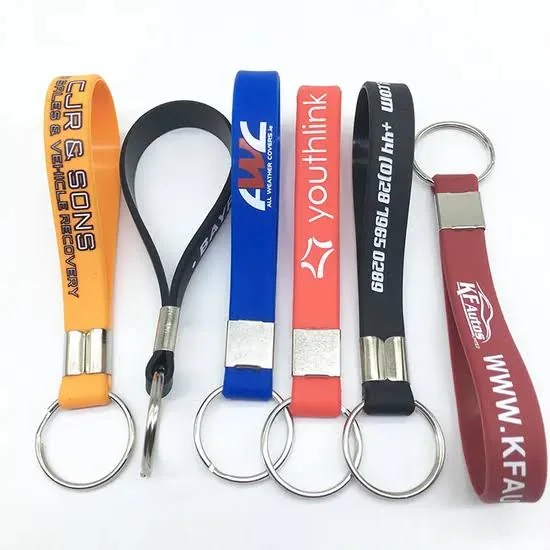
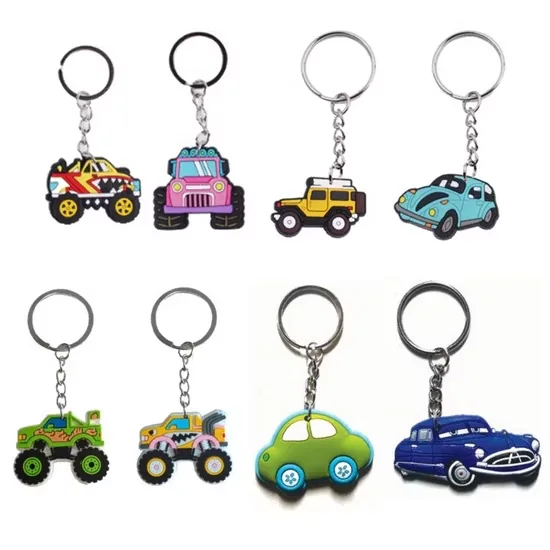
A strap runs long and narrow, with a hole or slot at one end and a printable body along its length. A charm sits compact on a split ring.
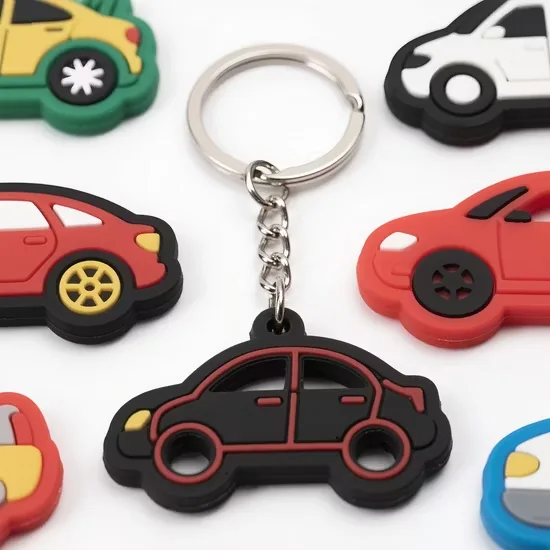
The strap gives you a continuous surface. Run a dealership name, a city, and a phone number along it and the type stays readable. The charm gives you a small enclosed area, enough for a logo mark, and it also lies flatter with your keys in a cup holder or jacket pocket than a thick 3D charm, which sits proud and catches.
Logo Visibility
Ask what the driver has to read from arm's length. If the answer is only your logo mark, a charm handles it: soft PVC reproduces raised or recessed detail well, so a silhouette, badge shape, or wordmark comes out clean. If the answer includes a phone number, website, or service line, you need length, since small raised letters in soft PVC lose definition and a strap gives that text room.
One production note affects your artwork. In our PVC keychain production process, colours are dispensed into the mold cavity one at a time, fine detail often by hand and larger fills by machine, so many small colour areas take more line time than fewer, larger ones. Simplify your artwork and you usually improve both price and appearance.
We publish no fixed minimum line widths or text heights, since they shift with part size, colour count, and construction. Send your artwork and our engineering team will tell you what holds before you commit to a mold.
Hardware: Where Common Wear Points Show Up
Common wear points on a promotional keychain include the ring, the clasp, and the plating, not just the molded body.
Our safety guide treats split rings, chains, and clasps as part of the tested product, checked for sharp edges, closure, pull strength, and coating, as part of the complete configuration rather than separately from the PVC body.
Ring or clasp type. A strap often takes a larger ring or a snap hook so it can carry a fob alongside the vehicle key. A charm usually takes a standard split ring. Tell us which, whether the driver needs to detach the fob quickly, and any plating required.
Pull strength check. Ask for a defined pull test on your approved sample, with the fixture, load, direction, and pass or fail threshold agreed in advance, and record the hardware spec for reorders. Our quality control checklist covers the gates that catch hardware problems before shipment.
Durability and Heat: What We Can and Can't Promise
A keychain in a car rubs against a gear lever, sits in a pocket with coins, and may sit in a hot cabin.
Soft PVC holds up well to daily carry when cured correctly; underbaked material can leave soft spots. Curing temperature is not the finished product's service temperature in a hot cabin, and cabin temperatures vary by market and season. We do not publish service temperature, UV, flex, or pull-strength ratings without sample testing. In a hot climate, order samples in PVC and silicone, test in real conditions, and ask for the test conditions behind any claim.
A long narrow part flexes more at the hole end. Ask for a reinforced eyelet or a thicker section there on your sample, then pull test it.
Match the Shape to the Campaign
| Use case | Recommended shape | Recommended hardware | Text volume | Main risk |
|---|---|---|---|---|
| Dealership handover gift | Strap | Larger ring or snap hook | Name, city, phone | Fob fit not checked pre-production |
| Service reminder giveaway | Strap | Standard split ring | Phone, service line | Text too small after shrinkage |
| Auto club or enthusiast group | Charm | Standard split ring | Logo mark only | Bulk discourages daily carry |
| Fleet management tag | Charm or short strap | Larger ring, tamper-resistant if needed | ID number, short mark | Similar tags confused without a clear ID |
| Trade-show giveaway | Charm | Standard split ring | Logo mark only | High cost per piece at low quantity |
Confirm against your own campaign; this can't cover every fleet or dealership policy.
Cost, Molds and Minimums
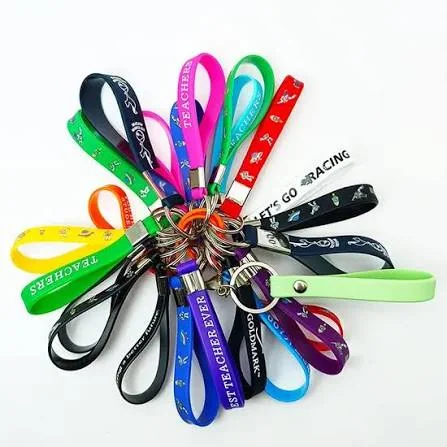
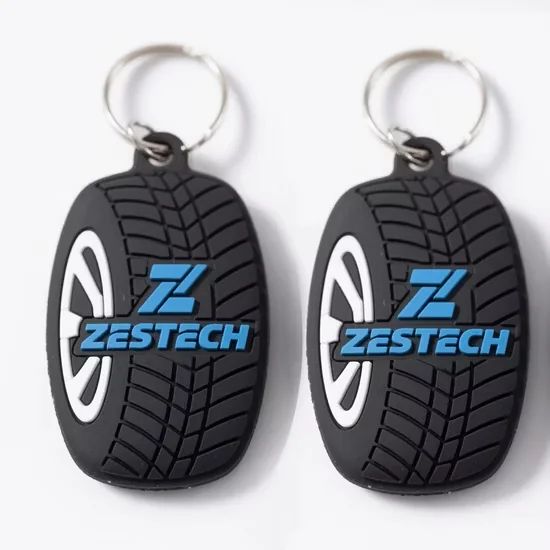
Every different shape needs its own tooling. Our mold fee guide states that fully different shaped products cannot share one mold, though multiple colour variants can, when the shape stays the same. A strap and a charm in the same campaign means two molds.
As of this review, that guide lists a 2D PVC mold from USD 120, a 3D mold normally adding about 30 percent, a zinc alloy mold from USD 100, and a silicone mold from USD 300. These are starting figures, not final quotes, exclude size, detail, and cavity count, and can move over time, so confirm the current figure before you budget. A strap is a bigger part, so expect a higher mold cost and a higher cost per piece than a charm at the same colour count and hardware.
Minimums follow construction. Our MOQ guide lists 100 to 300 pieces for 2D PVC, 300 to 500 for 3D PVC, and 300 to 1,000 or more for metal, with stock styles from 1 to 50 where no new mold is needed. Treat these as indicative starting points tied to this review date.
Ask us to quote your strap and your charm at the same size, colour count, and hardware, at two quantities each, and compare four real numbers.
Artwork Rights
Send artwork you have the right to use. You confirm you own or are licensed to use every logo, mark, and character in your design. We may decline artwork that appears to use a protected character or third-party mark without authorisation, but our approval is a production check, not legal clearance.
What to Send Us
Shape: strap, charm, or both for comparison
Artwork in vector format, or a sketch with the text you need to fit
Rough size, or the key fob the piece must sit alongside
2D or 3D construction, if you know
Quantity, plus a second quantity to compare
Ring, clasp, or snap hook preference, and any plating required
Pantone references and colour tolerance
Destination, ship-to city, Incoterm, and delivery date
Intended user, including whether it's aimed at children
Packaging preference, and whether you need a barcode
Send what you have. We will tell you what is missing.
Get Both Quoted
Send your logo, text, quantity, and the shape you're leaning toward. If undecided, send both and compare real numbers.
HuaSan Custom can prepare strap and charm options from the same artwork and confirm dimensions, colour, hardware, and eyelet construction at sample stage.
This guide is general information for buyers, not legal, compliance, or vehicle-safety advice. Confirm product-safety requirements for your market and check any accessory against your vehicle manufacturer's guidance.
Rubber Strap vs Standard Rubber Keychain FAQs
Can one mold make both a strap and a charm?
No. Different shapes need separate tooling, but one mold can produce many colour variants of the same shape.
Which style works better with a smart key fob?
Either can. A slim strap adds little next to a fob in a pocket. A large 3D charm looks strong on display but adds bulk, and some drivers remove it, which stops your logo from working. Test a sample with the actual fob before you commit to quantity.
What should be pull-tested?
The ring or clasp attachment on your approved sample, using a defined fixture, load, direction, and pass or fail threshold, not an informal tug. Record the result and the hardware spec so a reorder uses the same part.
Can you match my brand colours?
Yes. Send Pantone references and we match paste per colour, then approve a physical sample and agree a tolerance before mass production.
What compliance documents can you provide?
That depends on your destination market, intended user, and own protocol. Tell us those three at quotation and we will confirm which declarations, test reports, and inspection records apply.